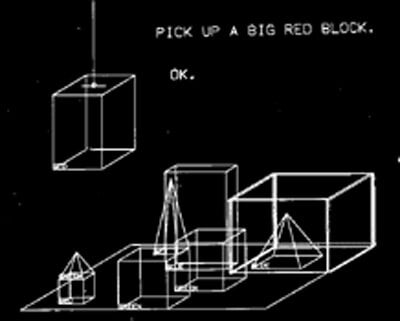
 SHRDLU in operation. Source: ResearchGate
“A language is not just words. It’s a culture, a tradition, a unification of a community, a whole history that creates what a community is.” — Noam Chomsky
Academic journals don’t usually dedicate an entire issue to a single paper, and fewer still publish a PhD thesis. In January 1972, Cognitive Psychology did both, giving over 191 pages to a single author’s work. The subject was a question the field had been wrestling with for fifteen years: can a machine genuinely understand language? Not match patterns or retrieve stored answers, but understand, well enough to act on an instruction, explain its reasoning, and recognise when something was unclear. Winograd’s program, SHRDLU, was the first system to do all three convincingly. It was described at the time as “head and shoulders above contemporary systems when it comes to intelligent conversation.”
To see SHRDLU running in 1971 was to watch a machine do something that had never been done before. Winograd had built a simulated robot arm operating in a world of coloured blocks and pyramids. Type a command in plain English and the arm moved. Ask why, and the system explained its reasoning in full sentences. Give it an ambiguous instruction and it asked for clarification. Every response was reasoned, not retrieved.
Winograd was building on the work of Chomsky. In 1957, Syntactic Structures had made a remarkable claim: that all human language, every sentence ever spoken in any tongue, is generated by a finite set of rules. The rules worked like code. For example, a sentence splits into a noun phrase and a verb phrase, each reducible further, all the way down to individual words. If those rules could be written down completely, a machine given the specification could understand language. It was an extraordinary promise.
SHRDLU worked because its world was small and complete. The blocks were everything: shapes, colours and locations, and nothing beyond. Step outside that world and the program had nothing to offer. Ask it about a chair, or whether it enjoyed the conversation, and it could not respond.
Language is ambiguous and resists rules. It is shaped by implication and the assumptions shared between speaker and listener. “I saw the man with the telescope” can be read two ways. In one, the telescope belongs to me and I used it to see. In the other, it belongs to the man I was watching. Both readings are grammatically correct. Only context tells you which sentence was spoken. Grammar has no mechanism for context.
Winograd saw this and documented sentences that no grammar could resolve and only common sense could resolve. In 2012, the Winograd Schema Challenge was created in his honour, built around exactly these sentences. It wasn’t until GPT-3 came along in 2020 that a machine could finally crack it, without being trained to do so.
Formal grammar could describe the structure of language with precision. Context was always beyond its reach, and without it a sentence is just structure. There was another way in and it looked nothing like a grammar.
Further Reading