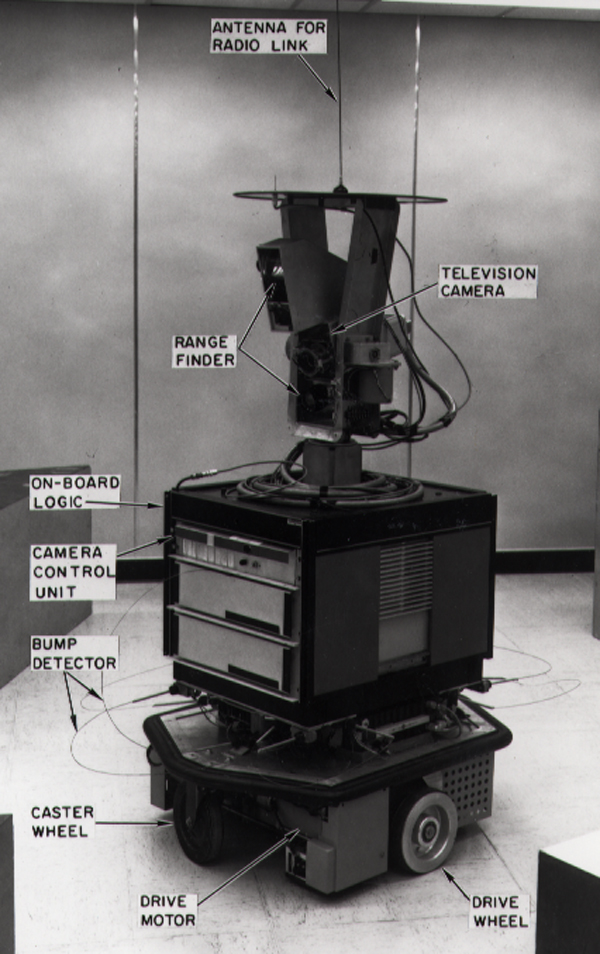
 Shakey, SRI International, CC BY-SA 3.0, via Wikimedia Commons
The history of AI is a history of ideas and failure.
Ideas come from anywhere intelligence is evident. The field has borrowed from logic, neuroscience, evolutionary biology, cognitive psychology, even the behaviour of ants. Problem solving is how we recognise intelligence. So these ideas get tested by building systems to tackle problems that require intelligence. If a system handles a hard problem, it demonstrates something that looks like thinking. But once a system becomes useful, usefulness is what matters. Whether we still call it intelligent becomes irrelevant.
Failure is inevitable. There is an old saying among AI researchers: as soon as it works, no one calls it AI anymore. This reveals something about how we define intelligence. We define it by what machines cannot yet do well. The moment they do it well, we reclassify. It becomes just software.
But engineers took these new problem-solving tools and used them to build solutions. Every day we use technology that started out as AI before quietly disappearing into the ordinary way things work. Here are three examples:
-
Spam filtering. In 2002, Paul Graham spent months writing rules to catch spam. Then he tried statistical analysis and found it was “much cleverer than I had been.” The machine learned that “ff0000” (HTML code for bright red) was as strong an indicator of spam as any explicit trigger word. It saw patterns humans couldn’t consciously identify. It exhibited judgment under adversarial conditions. Spammers actively mutate their tactics. The system had to recognize deception, adapt without instruction, and make decisions about ambiguous cases. It exceeded human conscious reasoning. Today, millions of spam messages are kept out of our inboxes using techniques that grew from these ideas.
-
Facial recognition. In 1964, Woody Bledsoe began teaching computers to recognize faces. The problem: humans do this instantly, effortlessly, unconsciously. But try writing rules for it. How do you describe the difference between two faces? The system had to handle variation in lighting, angle, age, and expression while detecting identity. In tests on 2,000 photographs, the computer outperformed humans. It demonstrated a core human perceptual ability that resists explicit description. The solution abstracted something essential about faces that humans couldn’t formalize. Today this is how your phone unlocks when it sees you.
-
Route planning. In 1968, researchers at Stanford Research Institute built Shakey, the first robot that could reason about its actions. Life Magazine called it “the first electronic person.” The A* algorithm gave Shakey the ability to plan routes, avoid obstacles, and recover from errors. Given a goal, it decomposed the problem, generated a plan, and executed it autonomously. This demonstrated planning, reasoning, and decision-making in an uncertain environment. Today, Google Maps uses A* alongside other techniques to help calculate your way home.
AI researchers have spent seventy years chasing a horizon that retreats as they approach. Behind them lies an ever-growing list of problems managed so well we forgot they were hard.
The past is full of unfinished business. This blog series will explore some of the ideas that make up AI. You never know, one of them might inspire you to build something that becomes ordinary tomorrow.
Let’s begin.
Links