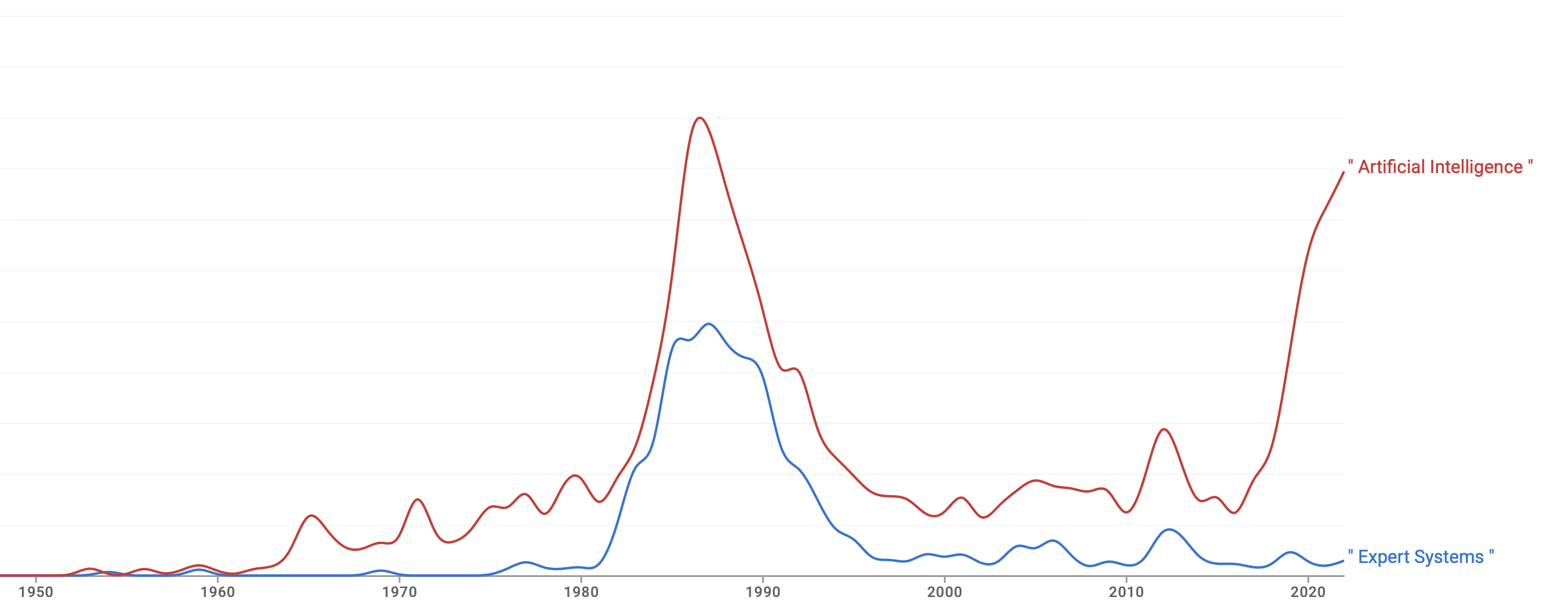
 Mentions of 'expert systems' and 'artificial intelligence' in books, 1950–2022. Google Ngram Viewer.
Here is the opening from a session called “The Dark Ages of AI,” at the world’s leading AI conference.
“In spite of all the commercial hustle and bustle around AI these days, there’s a mood that I’m sure many of you are familiar with of deep unease among AI researchers who have been around more than the last four years or so. This unease is due to the worry that perhaps expectations about AI are too high, and that this will eventually result in disaster.”
The year was 1984, at the height of the expert systems boom, when companies were standing up AI groups staffed by people who had read one book and attended a one-day tutorial. Drew McDermott asked the room to imagine the worst case. In five years time, imagine if the big strategic bets went nowhere, the startups all failed, and everybody hurriedly changed the names of their research projects to something else.
Eerily, the future unfolded almost exactly like that, though it took three years, not five. Expert systems had a structural problem the boom years had papered over. They were only as good as the rules you could extract from experts, and experts struggled to articulate what they actually knew. Systems were brittle outside their narrow domains, and the more rules you added, the harder they became to maintain. XCON, the system that had saved DEC $25 million a year, now required 59 technical staff to maintain it and still couldn’t keep pace with the ever-changing product line.
When cheaper hardware arrived, the economics collapsed. Sun workstations undercut LISP machines on price and Symbolics went bankrupt. Government programmes wound down, funding dried up, and companies across the industry quietly shut their AI groups. The word itself became professionally toxic. Usama Fayyad, finishing his PhD in AI in 1991, later recalled that no company would hire anyone who worked in the field.
What looked like a collapse was closer to a dispersal. The researchers scattered into adjacent fields, took their ideas with them, and kept working under names that didn’t attract attention or scepticism. The foundations of everything we now call AI were laid during a period when nobody wanted to fund it. In 2002, Brooks noted: “There’s this stupid myth that AI has failed, but AI is all around you all the time.”
Further Reading